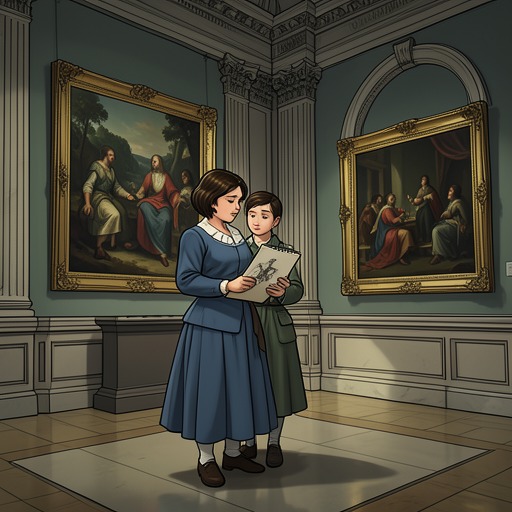
Kensington Museum
Little WomenKensington Museum is presented as one of the most memorable destinations of Amy Curtis March’s London visit. More than a stop on a fashionable tour, it becomes a place where travel, art, and self-education meet: Amy measures the experience through the works she sees, the impressions she gathers, and the subjects she hopes one day to render herself.
Setting and Visit
In a letter from Paris recounting the preceding London journey, Amy Curtis March places Kensington Museum among the excursions arranged with the Vaughns. She says that the visit to the museum pleased her more than anything else in London, ranking it alongside Hampton Court while distinguishing it as a concentrated encounter with major works of art. The museum therefore enters the narrative through memory and correspondence rather than through a directly narrated scene.
The Art Collection
Amy specifically recalls rooms filled with paintings by Turner, Lawrence, Reynolds, Hogarth, and other celebrated artists. The list gives the museum an atmosphere of abundance and authority: it is not merely a building containing isolated curiosities, but a place in which Amy encounters a succession of recognized masters. Her response is shaped by both admiration and professional ambition. She looks closely enough to imagine translating what she sees into her own work, making the museum a practical school as well as a source of delight.
Amy’s Artistic Perspective
The visit reveals how Amy experiences travel. In Richmond Park she notices oaks, deer, a nightingale, and larks as subjects she might copy; at Kensington Museum, the paintings become models against which her own artistic aspirations can be tested. Her attention is thus active rather than purely touristic. She does not simply report that the museum was impressive. She remembers the artists, the rooms, and the possibility of learning from them, turning cultural travel into part of her continuing formation.
Place in the European Journey
Kensington Museum belongs to a broader London itinerary that includes Hampton Court and Richmond Park, before Amy continues on to Paris. The hospitality of Fred Vaughn and Frank Vaughn makes these excursions possible, while Grace Vaughn becomes Amy’s close friend. The museum consequently stands at the intersection of social opportunity and artistic development: Amy travels within a welcoming circle, but she evaluates the journey according to what it gives her as an artist. Her later movement through Europe is not detached sightseeing; it is a sustained education in pictures, landscapes, languages, and cultivated society.
Narrative Significance
The museum’s importance lies in the way a brief remembered visit confirms Amy’s maturing identity. Elsewhere, domestic and neighboring spaces organize the sisters’ daily life: the garden separates March family home from Laurence mansion, the hedge becomes a boundary and later a route for communication, and the library at Laurence mansion offers Jo an overwhelming private world of books, pictures, statues, coins, curiosities, and bronzes. Kensington Museum extends this pattern into the public world. It is an institutional space where inherited culture is gathered and made available to an ambitious young woman. Through Amy’s letter, the museum becomes evidence that her artistic education is no longer confined to family possessions or local surroundings; she is learning to locate herself within a larger European culture and to convert what she sees into disciplined artistic knowledge.